

Machine Tool Technology
The Machine Tool Technology program prepares students for employment in machine shops, tool rooms, and instrument and experimental laboratories and provides upgrade opportunities for employed industrial personnel.
Business and Industrial Studies Guided Pathway Division
Students gain proficiency in the set-up and operation of drilling machines, lathes, mills, grinders, electrical discharge machines, Computer Numerical Control (CNC) lathes, CNC milling machines, and computer aided manufacturing systems. Competencies will be assessed regularly in accordance with skill standards established by the National Institute of Metalworking Skills (NIMS). At least 50 percent of the courses required for the major must be completed at Compton College.
Program Learning Outcomes
Upon successful completion of the degree program, students will be able to:
- Apply principles from mathematics, physics, and chemistry to solve applied problems in engineering.
- Identify different digital and analog sensor technologies.
- Follow and build robotic devices and components in accordance with industry standard schematics and diagrams.
- Solving Engineering Problems: students will apply principles from mathematics, physics, and chemistry to solve applied problems in engineering.
- Digital and Analog Sensor Technologies: Upon completion of the courses in this discipline, the student will be able to identify different digital and analog sensor technology.
- Industry Standards: Upon completion of the courses in this discipline, the student will be able to follow and build robotic devices and components in accordance with industry standard schematics and diagrams.
Program Mapper
Certificates of Achievement
CNC Machine Operator
The CNC Machine Operator certificate of achievement aims to provide basic to advanced
training in manual or conventional machining, computer numerical programming and operation,
advanced multi-axis programming and operation. These form the fundamental skills necessary
for the average and expected workload in the machining industry. Enrolled students
are strongly positioned for employment in the machining industry throughout the course
of the program.
Program Mapper
Machinist
The Machinist certificate of achievement program aims to provide basic to advanced
training in manual or conventional machining, computer numerical programming and operation,
and advanced multi-axis programming and operation. These form the fundamental skills
necessary for the average and expected workload in the machining industry. Enrolled
students are strongly positioned for employment in the machining industry throughout
the course of the program.
Program Mapper
Numerical Control Programmer
The Numerical Control Programmer certificate of achievement aims to provide basic to advanced training in manual or conventional machining, computer numerical programming and operation, advanced multi- axis programming and operation. These form the fundamental skills necessary for the average and expected workload in the machining industry. Enrolled students are strongly positioned for employment in the machining industry throughout the course of the program.Program Mapper
Frequently Asked Questions
Career Outlook & Salary Potential
Advanced manufacturing careers continue to grow across Los Angeles County. Skilled machinists and CNC operators are in demand across industries including aerospace, defense, automotive, and industrial manufacturing.Typical salary range in the Los Angeles region: approximately $55,000 – $75,000+ per year depending on experience, specialization, and employer. Experienced CNC programmers, toolmakers, and manufacturing specialists often earn significantly more as they advance.
1. What is the Machine Tool Technology Program at Compton College?
The program prepares students for high-demand careers in precision machining and advanced manufacturing. Students train on industry-grade CNC equipment including a Haas UMC 500SS 5-axis machining center and a Haas ST-20Y lathe with live tooling, the same machines found on production floors in aerospace, defense, and advanced manufacturing. The program also includes conventional knee mills and lathes, Bambu Lab 3D printers, and laser engravers, giving students broad exposure to both traditional and modern manufacturing technologies.
2. What skills will students learn in the program?
CNC machining and programming, conventional machining (lathe, mill, and grinder operations), CAD/CAM software and digital manufacturing workflows, blueprint and manufacturing print interpretation, precision measurement and inspection, machine shop mathematics, and advanced manufacturing processes, all while applying math, physics, and engineering principles to real-world problems.
3. What degrees or certificates are available in this program?
- Associate of Science – Machinist
- Associate of Science – Numerical Control Programmer
- Certificate – CNC Machine Operator
- Certificate – Machinist
- Certificate – Numerical Control Programmer
4. What careers can students pursue after completing the program?
Careers include CNC Machine Operator, Machinist, CNC Programmer, Manufacturing Technician, Tool and Die Maker, and Precision Machining Specialist in industries such as aerospace, automotive, defense, medical device manufacturing, and advanced manufacturing.
5. What industry standards does the program follow?
The program aligns with National Institute for Metalworking Skills (NIMS) standards to ensure students develop competencies recognized by employers in the machining and manufacturing industry.
6. Is the program hands-on?
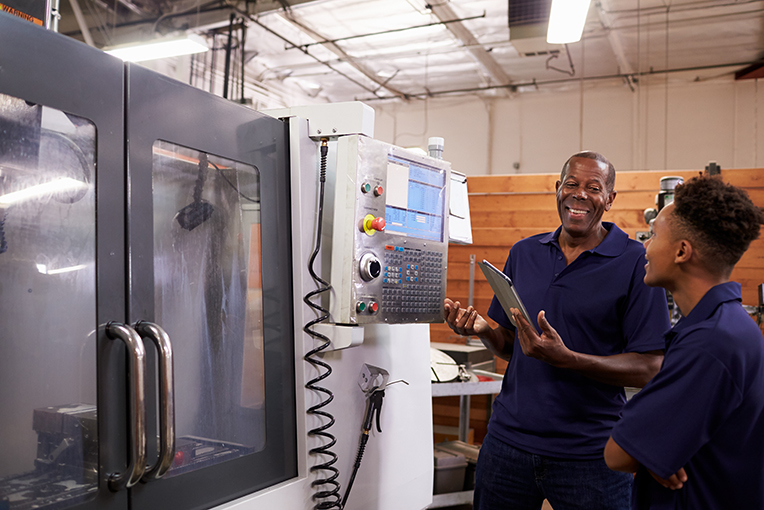
Yes. The program emphasizes hands-on training in a machine shop environment. Students work directly with industry-standard equipment to develop the practical skills required for immediate entry into the workforce.
7. How long does the program take?
Many students can complete a certificate in approximately one year, while the Associate of Science degree can typically be completed in two years, depending on course load.
8. Who should consider enrolling in the Machine Tool Technology program?
This program is ideal for students interested in hands-on technical careers, individuals who enjoy working with machines and technology, career changers seeking stable high-demand work, and industry employees looking to upgrade their machining and manufacturing skills. It is also well suited for companies seeking to develop their workforce through structured CNC and advanced manufacturing training.
9. What is the total estimated cost of the program?
- Tuition: $46 per unit (16 units = $736).
- Textbooks: $0 (Open Educational Resources).
- Student Activity Fee: $10.
- Health Fee: $19.
- Student Representation Fee: $2.
start here
course catalog
Contact Information
Sam Agdasi
Dean of Student Learning
Office VT 150, (310) 900-1600 ext. 2273
sagdasi@compton.edu
Michael Vanoverbeck
Division Chair
Office VT164, (310) 900-1600 ext.2660
mvanoverbeck@compton.edu
Machine Tool Technology Faculty
Michael Vanoverbeck
FT Faculty
Office VT164, (310) 900-1600 ext.2660
mvanoverbeck@compton.edu


We're Here to Help! Create Your Success Story at Compton College.
START HERE


